


A case study in conservation framing significant objects: J-MAC memorabilia
Some objects hold a moment so completely that looking at them feels like stepping into the memory or story itself. A grandfather’s war medals still pinned to their original ribbon, an ancestor’s pocket watch, spectacles, or a family Bible softened by generations of hands, a baby’s first coming‑home outfit — each carries its own story. Sporting memorabilia sits alongside these heirlooms: a signed jersey from a sportsperson or team woven through someone’s long‑held sporting loyalty, a baggy green cap or wickets from a defining cricket match. We also keep collectables brought home from places that mattered. Organisational and corporate artefacts belong in this picture too — pieces that record a company’s history, achievements and identity across time.
We hold on to these things because they are evidence of moments that matter. Framing objects like these is why conservation framing exists — and it sits at the heart of ARTSHOP’s purpose as a conservation framing studio. One of the most privileged commissions to pass through our Toowoomba workshop this year involved two significant pieces sourced by Brian and Kerry Carroll of Carroll Truck Sales: a signed riding crop and a photograph from a history‑making horse race, both donated to the recent LifeFlight Toowoomba Gala for their future custodians. This project is a clear example of preservation‑led design applied to objects beyond traditional works on paper or canvas, and in this blog we use it to explore how thoughtful, conservation‑grade framing supports and protects items of significance.
Why objects deserve conservation framing
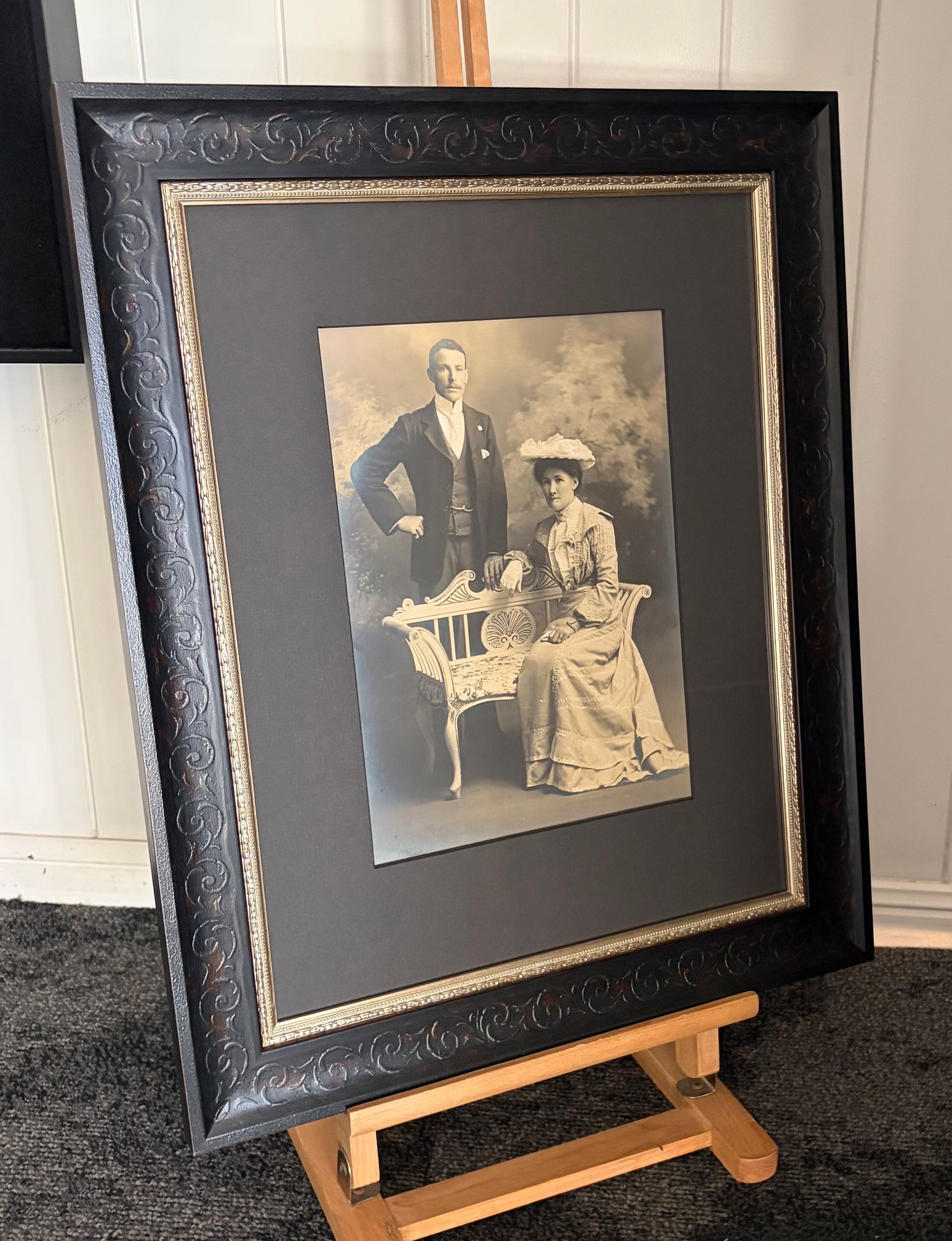
Objects, heirlooms and memorabilia arrive at ARTSHOP in many forms. Some are two‑dimensional — documents of significance such as a young child’s painting, vintage photographs, certificates or hand‑written letters — each carrying its own story and preservation needs. These behave like paper: expanding and contracting with environmental changes and requiring framing that allows movement rather than restraint.
Others are three‑dimensional, such as medals, textiles, jerseys and other family heirlooms or memorabilia. These have weight, depth and shape, and require a structural approach.
What both types of objects share is that they’re often stored rather than displayed. Many end up in drawers, cupboards or boxes — not because they lack significance, but because their owners aren’t sure how to store or display them safely and beautifully.
That’s a loss, because everyday storage doesn’t truly protect them. Even tucked away, objects remain vulnerable to dust, humidity and gradual deterioration. Whereas with conservation framing, the same piece can be enjoyed every day while being better safeguarded than it ever was in storage.
Brian and Kerry Carroll of Carroll Truck Sales understood the significance of the items they had sourced for the Gala. The Darling Downs has a large and passionate equine community, and the Carrolls recognised that these pieces would resonate deeply. Their decision to entrust the signed riding crop and signed race photograph to a conservation framing studio reflects the respect they held for the moment these objects represent.
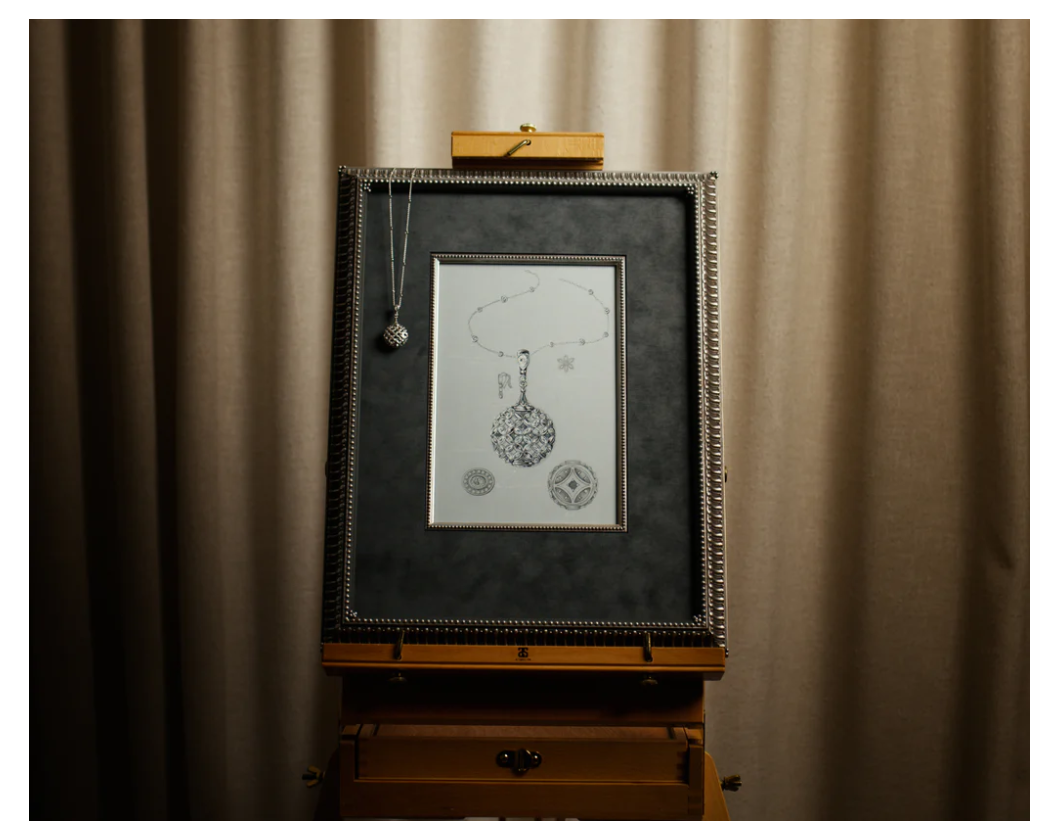
ARTSHOP donated the conservation framing for these items, as we have in recent years for another of the Gala’s major philanthropic offerings — the illustration of the heirlooms donated by Hogans Family Jewellers for the exciting Balloon Pop raffle. It’s our way of contributing our craft to a service that supports our Darling Downs community.
What can be framed, and why this set was distinctive
Conservation framing evolved from the archival practices used in galleries and museums, primarily to protect works of art — but those methods aren’t just for institutions. They’re equally important for objects that hold personal or historical meaning. Signed memorabilia, medals, textiles, bound volumes, historical photographs and other rare or heirloom artefacts can all be framed safely, provided the framer understands the materials, how they behave over time and the methods required to support them.
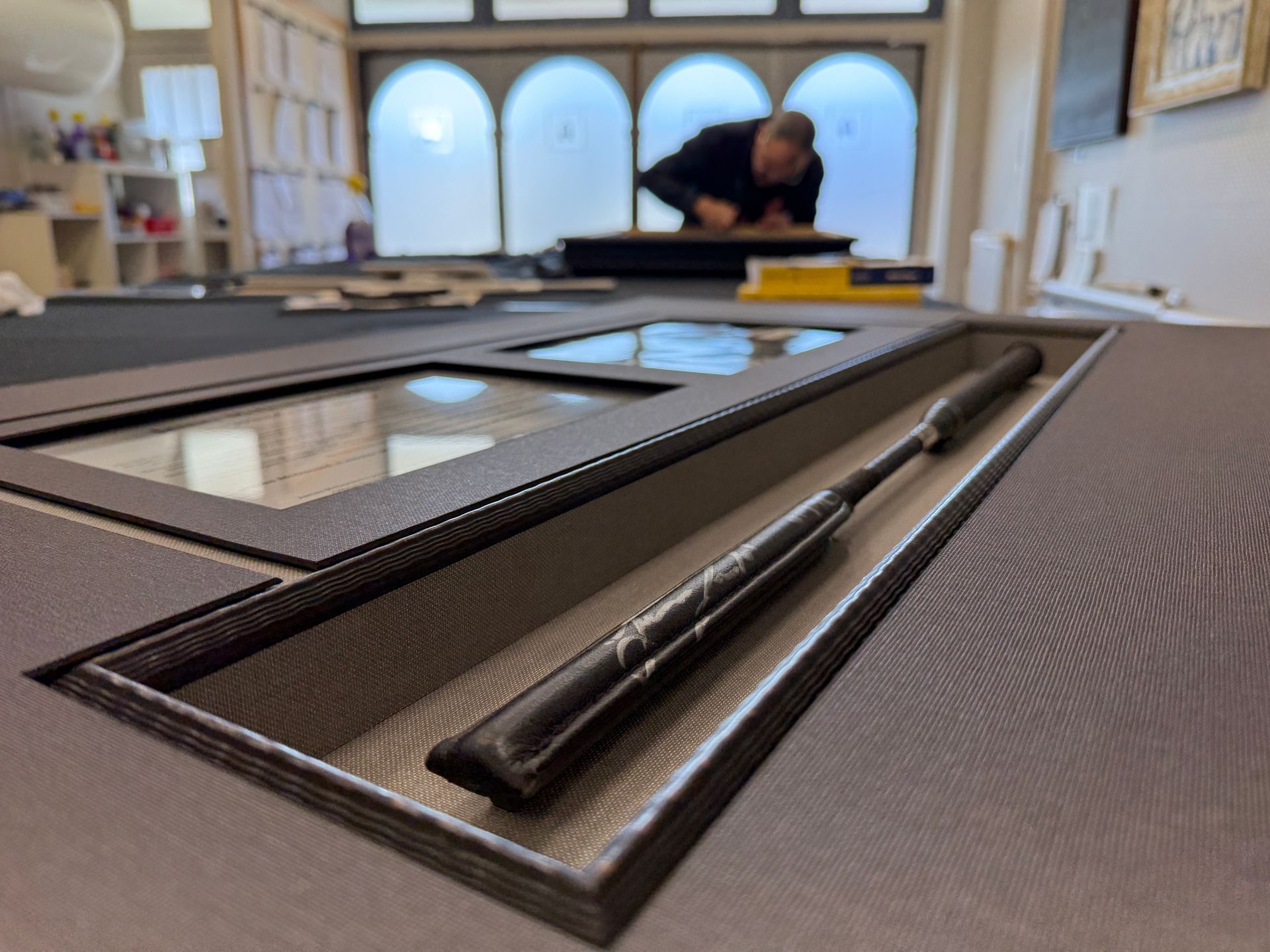
The J-MAC project initially brought together two very different objects: a photographic print, a leather and wood riding crop. Then, in consultation with the Carrolls, ARTSHOP commissioned a third element: an engraved silver plaque to help tell the story of these pieces and communicate their significance. Each object required its own approach to support and frame it, yet all needed to sit together as one cohesive piece.
The first challenge was depth. A riding crop has varying materials, thickness, an extended length and some weight to it. A plaque has a fixed, elevated profile with hard edges and enough depth to create its own shadow line within the frame. A photograph sits almost flat. To frame them together, a design structure was needed that supported each object individually while presenting them as a unified story.
Technical construction and conservation mounting
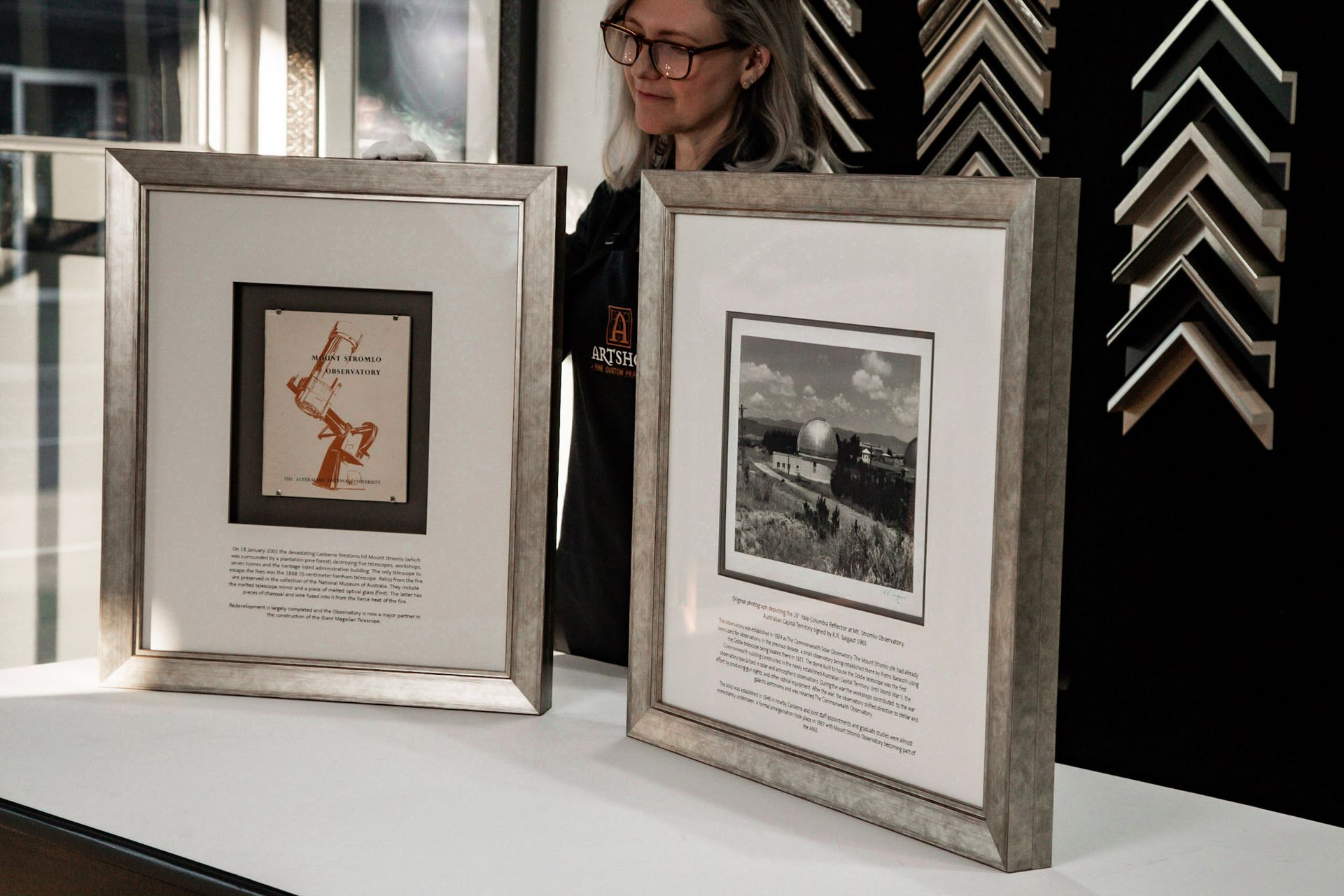
The custom framing process for objects like this can be very complex and requires informed design and planning. This piece needed multiple internal windows, each built to a different depth to house the individual objects, engineered to ensure they sit securely and never touch the glazing. It was a true team effort from the ARTSHOP framers — each contributing aesthetic ideas and stabilising solutions to ensure the final design was structurally sound and visually cohesive.
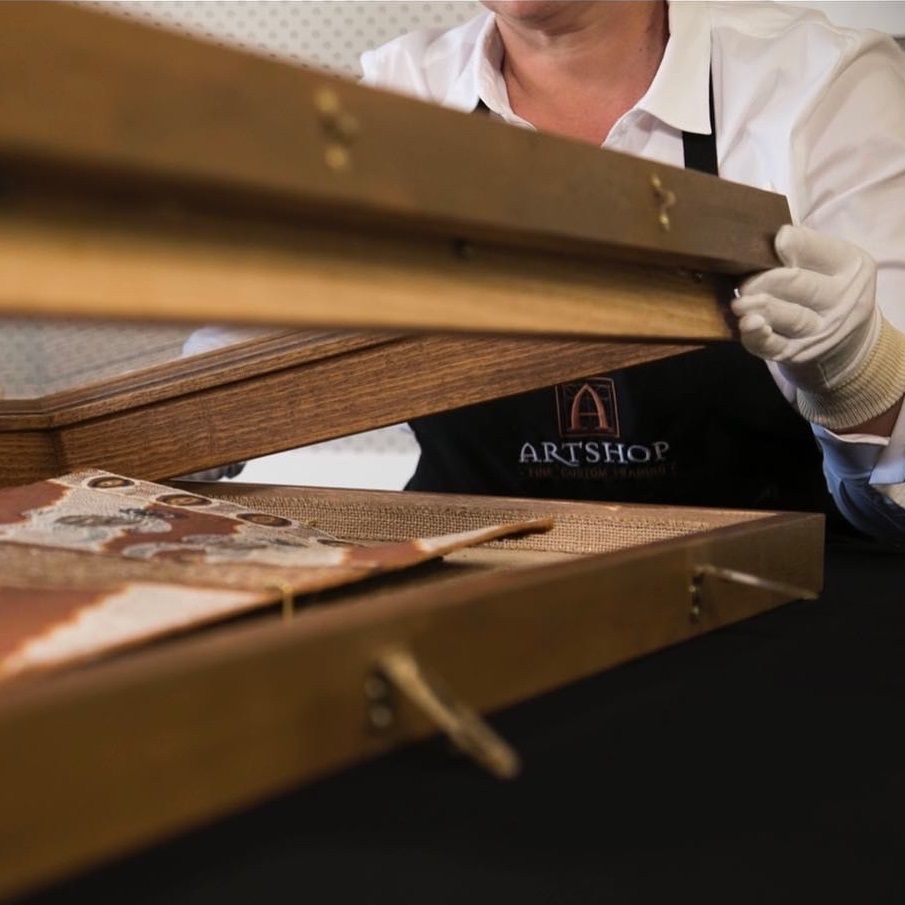
To meet conservation standards, each object was mounted using fully reversible methods to ensure its integrity throughout time and the piece’s future. We used hidden stitches, fine archival wires, custom mounts and discreet hinges to support each piece structurally without altering it. The internal surrounds were finished with complementary‑toned, museum‑standard fabric matting, and the entire work was glazed with full‑UV‑filtering, anti‑reflective Tru Vue Museum Glass®, a form of glazing designed specifically for preservation.
The story behind the objects
The items in this commission trace back to an afternoon in December 2022 at Sha Tin Racecourse in Hong Kong. Riding Romantic Warrior, James McDonald — J MAC — delivered a history making performance in the LONGINES Hong Kong Cup. The pair claimed a rare four-and-a-half-length victory, set a 2,000 metre speed record that still stands, and secured what would become the first of four consecutive Hong Kong Cup wins, the most by any racing history.
McDonald is now regarded as the world’s best jockey and one of the finest thoroughbred riders of all time. He is the most successful Australian‑based Group 1 jockey to date, recently securing his 130th major title and surpassing the legendary Damien Oliver, who held the previous Australian record of 129 Group 1 wins. James McDonald has also won the prestigious LONGINES World’s Best Jockey award three times — in 2022, 2024 and 2025. Raised on a family farm in rural New Zealand, he learned to ride among the rolling hills that shaped his early years. On race days, he carries a small piece of paper with four words written on it: See it. Feel it. Win it. Enjoy it.
The riding crop used in the 2022 LONGINES Hong Kong Cup victory, together with the official race photograph, became the centrepiece of this framed commission for LifeFlight Toowoomba — two objects carrying one extraordinary moment. They are artefacts of that moment, with the plaque interpreting it for those who weren’t there and ensuring the story travels with them long after memories fade, strengthening their meaning and investment value.
The significance of this commission
For our ARTSHOP team, this commission carried meaning beyond the technical work. It was an opportunity to honour Carroll Truck Sales’ generous gift and support LifeFlight Toowoomba. Pieces like this remind us why conservation framing matters: it protects not just objects, but the stories behind them. Working with Brian and Kerry Carroll to honour J‑MAC’s story was a true privilege — ensuring a piece of sporting history could be returned to the community in a way that will endure long after the event itself.
When clients bring objects to ARTSHOP, the first step is always understanding the story — where it came from, what it means, and the space it will live in. Every object has its own character and history, and those qualities shape the design that follows. A nineteenth‑century photograph won’t want the same presentation as a baby’s first homecoming outfit, a set of service medals, or a community‑sport memento. A weathered medal calls for a treatment that respects its era and materials, while a contemporary item may suit a cleaner, more minimal finish.
Once the story is understood, we follow a museum‑standard sequence to ensure the object is protected before it is manufactured. We begin with the object itself — its material, age, fragility and surface sensitivity — then determine its conservation requirements, such as reversibility, humidity response and light sensitivity.
We then address support and engineering. Some objects need discreet internal structures; others require shadow‑box depth, concealed platforms or custom mounts. Works on paper may need conservation hinge‑mounting for humidity movement, while dimensional objects might rely on hidden stitches, archival wires or unobtrusive cradled supports to distribute weight evenly.
With the object secure, we refine proportion and layout, colour and texture through matting, fabrics and finishes. We choose the appropriate glazing level, such as UV‑filtering, anti‑reflective museum glass, and ensure the frame is sealed and stable for the long term.
A frame should support the object, not compete with it. At ARTSHOP, we see custom conservation framing as an artform — a considered extension of the piece it surrounds, elevating its presence while providing the protection it needs to endure.
Living with and caring for a conservation framed piece
Toowoomba’s bright skies mean high UV exposure, and even indirect sunlight can fade pigments and weaken organic materials over time. Tru Vue Museum Glass® helps guard against this, but placement still matters: a wall out of direct sun and away from heat sources is one of the most effective protections.
Climate also shapes day‑to‑day care. Dust stirred up in dry spells, combined with humidity, can encourage mould if left undisturbed. A soft, dry cloth and gentle cleaning are usually enough. Good airflow and stable humidity further support longevity. If a piece shows signs of damp or age, ARTSHOP offers professional inspection, assessment and restoration.
You can read more in our blog "Art and picture framing: Protecting your pieces in Toowoomba's variable climate".
Ready to Protect Your Piece
Somewhere in Toowoomba, the framed J-MAC memorabilia has found its new home and that wall is indeed a proud place. The rider’s crop that once urged a champion thoroughbred to a record-breaking finish, the photograph that captured the moment, and the plaque that records its significance now sit together in a frame built to protect them for years to come.
We’re grateful to Brian and Kerry Carroll for entrusting us with this piece of sporting history, and to its new custodians for the generosity that helped raise over $10,000 in support of LifeFlight Toowoomba.
If you have an object, memorabilia, corporate artefact or collectible you’d like professionally assessed, preserved or framed, we welcome you to visit the ARTSHOP studio in Toowoomba or contact us to arrange a consultation with our conservation framing team. Since 1990, clients across South East Queensland have trusted us with artworks, historical objects, heirlooms, corporate artefacts and personal treasures of every kind. Using conservation‑standard methods and archival materials, our team ensures each piece is beautifully presented, structurally supported and protected for the long term. As members of the AICCM and the Picture Framers Guild of Australia, we uphold the highest professional standards — so you can feel confident your piece is in safe hands.